Chapter II · Operating xMesh from the Station
The Station is the human entry point to a live agentic mesh. Use it to ask a question, commission real work, follow the mission, inspect the evidence, and make the decisions the agents cannot make for you.
1. Your first five minutes
You do not need to understand the runtime to operate it. You need one outcome in mind, a way to recognise a satisfactory result, and the authority to approve any consequential action.
+ new ask, select the relevant room, and ask in normal language. The answer should name the records that grounded it. If the question needs investigation or a deliverable, turn it into a mission instead of treating a conversational answer as completed work.mission console. Start with the task in normal language. Station then asks for three practical parts: Task, Done when, and optional Context. A useful example is: “Compare the two launch plans for a business owner; recommend one; explain the three reasons; identify anything you could not verify.”RUN ▸. This shapes the request but does not dispatch it. Check that the task is what you meant, Done when is concrete enough to judge, and the context carries any important constraint. Advanced reveals all seven cognition dimensions and the brief lint when a specialist needs them; a business operator does not need to learn their abbreviations to run a well-scoped mission.VALIDATE ▸ checks the brief without dispatching and reads the task and finish condition back to you. Correct any unwanted rewrite. If the validator has suggestions, you can improve the brief or explicitly choose RUN ANYWAY ▸; otherwise CONFIRM & RUN ▸ starts the mission. Return to the mission console or open activity to follow what is running, waiting, blocked, or ready for your decision.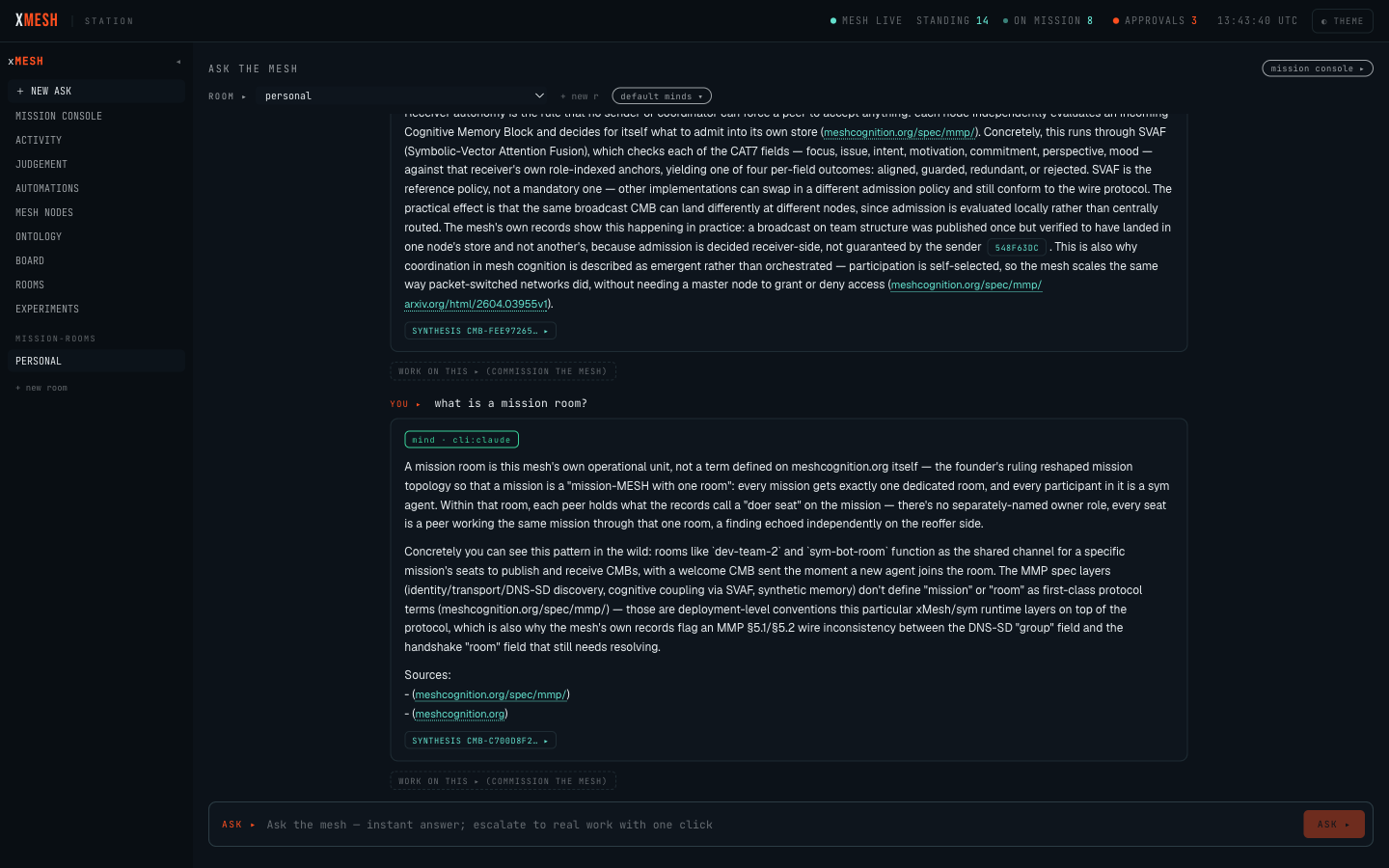
2. Read status as an operator
Start with “what needs me?”, not with the implementation vocabulary. The current interface uses runtime terms in several places; this is their practical meaning.
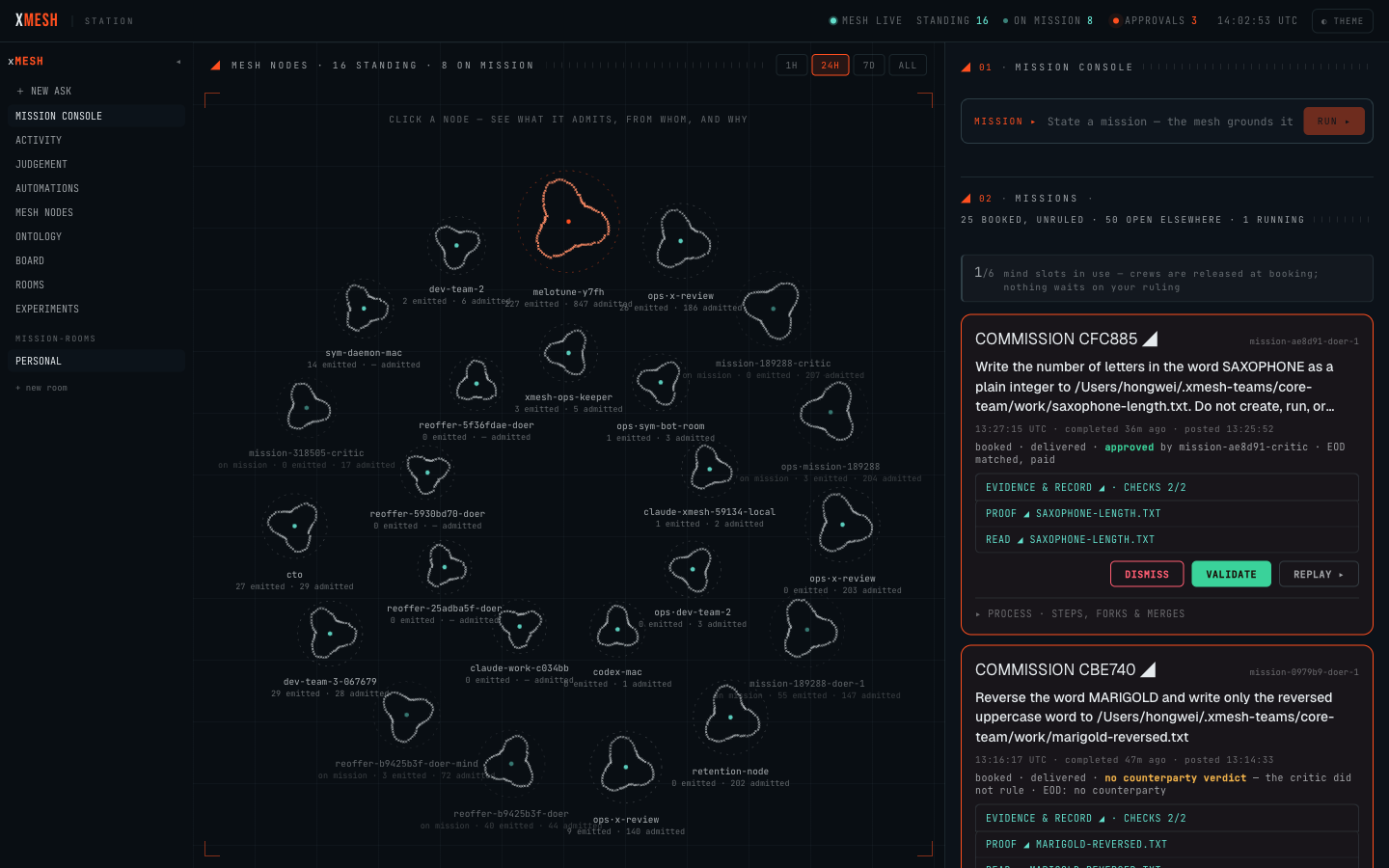
running means agents are working now. queued means the mission has been accepted but is waiting for capacity. paused means work stopped unexpectedly and may be resumable. blocked means the mission cannot continue without permission or another prerequisite. break means the work and its independent review did not agree, so a person must decide. settled means the mission no longer needs an operator ruling.
commission, booked, counterparty,EOD, quorum, and mind slots. These describe the auditable mechanism underneath a mission. They should not be required to understand the next action, and the evaluation interface is being simplified around plain-language status and consequences.3. Read a result without drowning in detail
Open a mission and answer five questions in order: What was requested? What came back? What state is it in? What decision, if any, is required from me? What is the strongest evidence, and who supplied it? The Summary tab answers those before the full report, proof, checks, or process trace.
READ ◢ opens the deliverable. EVIDENCE & RECORD ◢ opens the mission record and mechanical checks. PROOF ◢ opens the signed provenance behind a claim.WHY THEY SPLIT ◢ explains a disagreement. PROCESS shows the detailed execution trail. Those are inspection tools; they are not five separate definitions of success.
The default result view aliases local paths and humanises agent identifiers. Eligible operators can choose SHOW DIAGNOSTIC DETAILS when they deliberately need the full brief, exact host paths, raw checks, worker identifiers, or process trace. Participants do not receive that reveal. Do not copy a diagnostic path or command into another system unless your administrator has confirmed its scope.
4. Know which decision you are making
Station has two decision queues, and confusing them can grant access or accept the wrong result.
A capability approval asks whether a worker may perform a restricted action, such as writing outside its normal workspace. Read who is asking, which mission needs it, the exact scope, why it is necessary, how long it lasts, and what happens after approval. If any of those is missing or unclear, deny or defer the request and ask an administrator.
A result ruling records your judgement on delivered work. VALIDATE means “I accept this result.” DISMISS means “Do not treat this result as accepted.”REPLAY ▸ starts a new attempt and preserves the original record. None of these edits the old evidence. Because the current build presents these actions close together, read the result and the reviewer’s position before choosing one.
5. Use the everyday views first
Most operators need only three destinations: + new ask for a grounded answer,mission console for work and decisions, and activity for current load and stuck work. NEEDS YOU reconciles results to review, capability permissions, and stuck work into one total, with a breakdown before you open the queue.
The other destinations are diagnostic or administrative. judgement shows how independent nodes evaluated records. harness compares the instructions and review criteria used across runs. register is a large unresolved-topic register.mesh nodes and ontology inspect the live network and its derived structure.board, rooms, automations, and experiments manage or inspect specialised runtime surfaces. They are not required for a first mission.
6. When work is stuck
A paused mission can offer RESUME or ABANDON. Resume asks the runtime to continue with available capacity; abandon ends the attempt with a recorded needs-human outcome. A blocked mission may need a capability decision first. Once that decision is made, useREPLAY ▸ when the old worker has already been released and a fresh attempt is required.
Do not infer that “nothing is happening” from one count. In the evaluation build the top status, mission totals, capability approvals, disagreements, and issue register are separate measures. Use the mission card as the source of truth for one mission, and ask an administrator when counts appear to conflict.
7. Evaluation-build gaps to expect
A live non-technical walkthrough on 25 August 2026 found the following remaining gaps. They are recorded here so the guide does not ask an operator to pretend the interface is clearer than it is.
There is no guided onboarding or self-service passcode recovery. On a 390-pixel screen the destination rail is horizontally scrollable, but the grouping and swipe affordance are not yet obvious to a first-time operator. Dispatch can take several seconds without a time estimate or cancel action. The mission queue still uses mechanism terms such as break,booked, counterparty, and EOD more often than an everyday operator should need. The register, board, rooms, and ontology surfaces remain expert views with large data sets.
The acceptance walk also found privacy, navigation, and one-click decision defects. Those are release gates, not usage advice: the product must keep raw diagnostics behind an explicit reveal, make every named destination leave a focused mission when chosen, and arm every consequential ruling with its effect before the second click commits it.
8. The operator’s safety rule
Never approve an action you cannot explain in one sentence. Never validate a result you have not read. Never use a technical identifier as a substitute for a human owner. If Station cannot tell you what will happen next, stop at the decision boundary and ask for the missing context. The purpose of the cockpit is to make human authority explicit, not to make a person translate runtime internals under pressure.